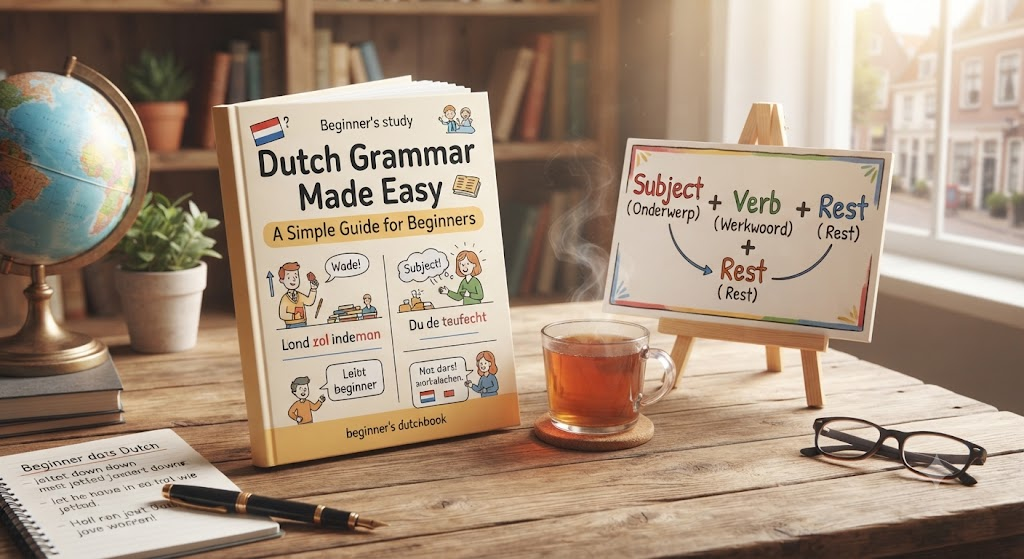
Learning a new language feels like a big adventure. If you want to speak Dutch, getting comfortable with Dutch Grammar is your best first step. Many people think European languages are hard to learn, but Dutch is actually one of the easiest languages for English speakers. Because English and Dutch are close cousins, many words look alike and share similar roots.
When I started exploring the language, I realized that understanding basic sentence structure quickly builds confidence. You do not need to memorize huge grammar books right away. Instead, you just need a clear map that breaks down the basic building blocks step by step. This guide covers everything from articles to verb conjugation in a very simple way.
Quick Summary: Core Dutch Grammar Rules at a Glance
| Grammar Topic | Key Rule | Example |
| Articles | Use de for most words and plurals; use het for neuter words. | de man (the man), het huis (the house) |
| Word Order | Subject + Verb + Object in simple sentences. | Ik lees een boek. (I read a book.) |
| Verbs (Present) | Drop -en from the infinitive to find the stem, then add endings. | kijken $\rightarrow$ ik kijk, jij kijkt |
| Plurals | Add -en or -s to the singular noun. | hond $\rightarrow$ honden, tafel $\rightarrow$ tafels |
| Adjectives | Add an -e ending, except before singular het-words with een. | een mooi huis vs. de mooie auto |
| Modal Verbs | Main verb moves to the very end of the sentence. | Ik wil koffie drinken. (I want to drink coffee.) |
What Makes Dutch Grammar Special for Beginners?
The world of dutch grammar is surprisingly logical once you understand its foundation. Unlike languages with dozens of complicated verb endings, Dutch keeps things streamlined. You will find that many rules follow consistent patterns without too many random surprises.
If you already speak English, you hold a massive head start. Hundreds of vocabulary words look almost identical in both languages. Understanding how sentences fit together will give you the tools to start speaking on day one.
Understanding De and Het Articles in Dutch Grammar
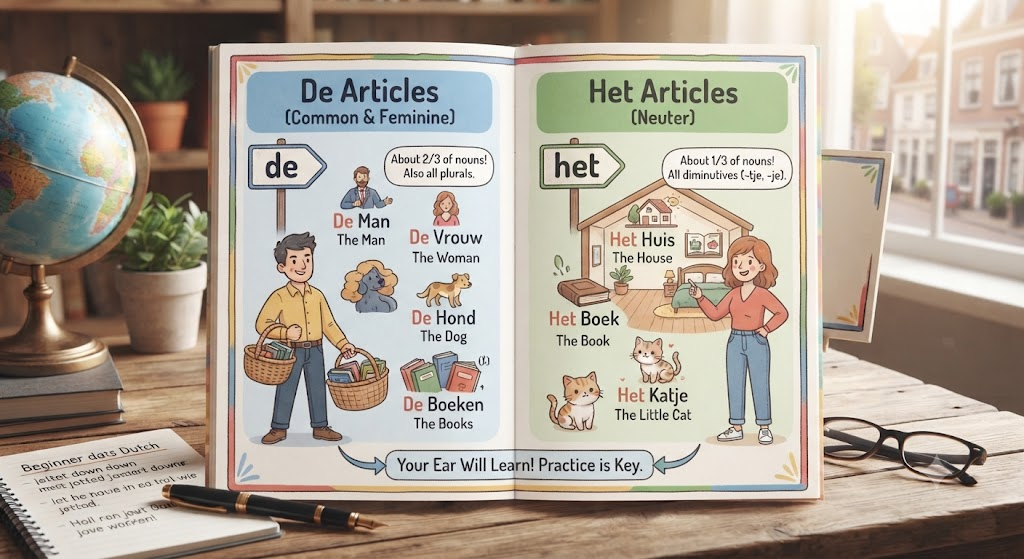
One fundamental part of dutch grammar involves choosing the correct word for “the.” Dutch has two definite articles: de and het. Knowing which one to use takes a little practice, but clear guidelines make it easier.
About two-thirds of all Dutch nouns use de, while the rest use het. Plural nouns always take de, regardless of their singular form. Diminutive words ending in -tje or -je always take het. Over time, your ear will naturally pick up which article sounds right.
Master Simple Dutch Pronouns First
Personal pronouns let you talk about yourself, your friends, and the world around you. In dutch grammar, pronouns are straight to the point and very easy to memorize.
- Ik means I
- Jij (or je) means you
- Hij means he
- Zij (or ze) means she
- Het means it
- Wij (or we) means we
- Jullie means you all
- Zij (or ze) means they
Using these short words daily helps you build simple statements right away.
Present Tense Verb Conjugation Rules
Conjugating verbs is a core piece of dutch grammar that every beginner needs to practice. The present tense relies on finding the verb stem, which you get by removing -en from the infinitive action word.
Once you have the stem, follow this regular pattern:
- For ik, use the pure stem (ik werk – I work).
- For jij, hij, zij, and het, add a -t to the stem (jij werkt – you work).
- For plural subjects (wij, jullie, zij), simply use the full infinitive verb (wij werken – we work).
This simple formula works for almost every regular verb in the language.
How Dutch Grammar Handles Sentence Word Order
Word order is an area where dutch grammar differs slightly from English. For basic main clauses, the order follows Subject + Verb + Object, just like in English.
For example, Ik eet een appel translates directly to “I eat an apple.” However, the main verb must always sit in the second position of the clause. If you start a sentence with a time phrase like “today,” the verb stays second, pushing the subject to the third spot (Vandaag eet ik een appel).
Making Plural Nouns Simple and Easy
Forming plurals in dutch grammar requires only two primary endings: -en and -s. Most standard nouns take -en at the end of the word.
For example, boek (book) becomes boeken (books). Nouns that end in unstressed vowels or sounds like -el, -em, -en, or -er usually take an -s instead, such as tafel turning into tafels. Remember that all plural nouns use the article de.
Adjective Endings and When to Add -E
Adjectives describe nouns, and dutch grammar applies one primary rule for adjective endings. In most situations, you simply attach an -e to the end of the descriptive word.
You say de grote hond (the big dog) or een mooie dag (a beautiful day). The only exception happens when three conditions meet: the noun is singular, uses the article het, and has an indefinite article like een in front of it. In that specific case, you leave the adjective in its base form (een groot huis).
Working with Dutch Modal Verbs
Modal verbs like kunnen (can), willen (want), and moeten (must) help express wishes, abilities, and obligations. In dutch grammar, using a modal verb alters the position of other verbs in your sentence.
When you use a modal verb in the second position, the second action verb gets pushed all the way to the very end of the sentence in its full infinitive form. For instance, “I want to learn Dutch” becomes Ik wil Nederlands leren.
Asking Questions in the Dutch Language
Asking questions using correct dutch grammar is straightforward once you try verb inversion. To turn a regular statement into a yes-or-no question, simply swap the order of the subject and the main verb.
If the statement is Je spreekt Engels (You speak English), turning it into a question makes it Spreek je Engels? (Do you speak English?). You can also place question words like wie (who), wat (what), waar (where), or hoe (how) right at the beginning.
Past Tense Rules in Simple Steps
Expressing past events in dutch grammar follows two distinct paths: the simple past tense and the present perfect tense. Most everyday conversations rely heavily on the present perfect tense.
To form the present perfect, combine an auxiliary verb (hebben or zijn) with a past participle. Past participles usually start with ge- and end with a -t or -d. Learning this pattern makes talking about your past experiences effortless.
Common Dutch Grammar Mistakes to Avoid
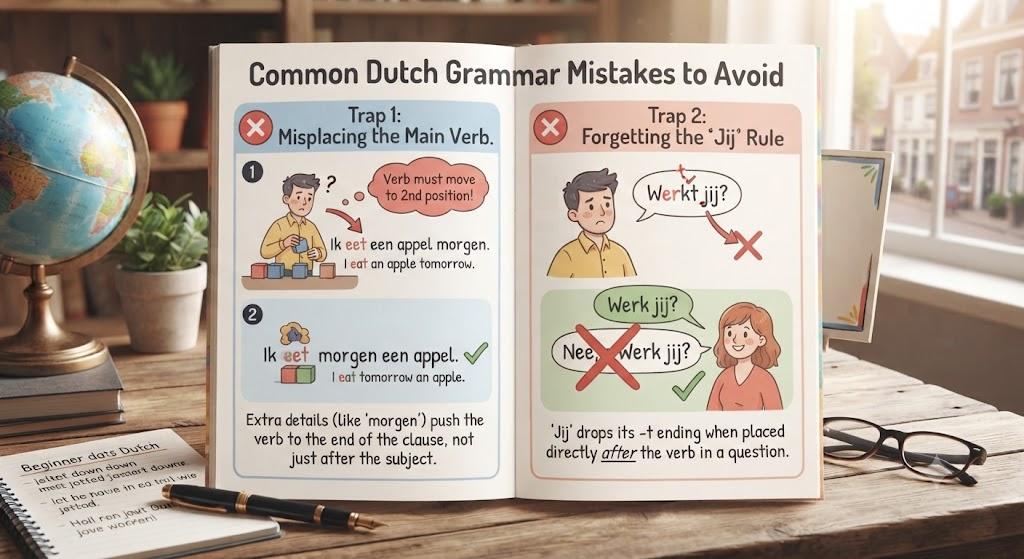
Many learners making their way through dutch grammar fall into predictable traps. One common mistake is misplacing the main verb when adding extra details to a sentence.
Another mistake is forgetting that jij drops its -t ending when it appears directly after the verb in a question (Werk jij? instead of Werkt jij?). Keeping an eye out for these small details will make your speech sound polished and natural.
Frequently Asked Questions
Is Dutch grammar hard for English speakers to learn?
No, it is widely considered one of the easiest foreign languages for English speakers. Both languages share Germanic roots, similar vocabulary, and comparable sentence structures.
What is the best way to remember de and het articles?
Always learn new nouns together with their article. Instead of memorizing huis, memorize het huis as a single unit from the start.
Why does the verb move to the end of some Dutch sentences?
When you use modal verbs or subordinate clauses starting with connectors like mdat (because), rules shift the secondary verb to the very end of the clause.
How do I know whether a word gets a -t or -d in the past tense?
Learners use a popular memory rule called “‘t kofschip.” If the stem of the verb ends with one of the consonants in that phrase (t, k, f, s, ch, p), the past tense ending uses -t.
Are there many irregular verbs in the language?
Most verbs follow regular conjugation patterns. However, high-frequency verbs like zijn (to be) and hebben (to have) are irregular and should be memorized early on.
Can I speak good Dutch without knowing every rule perfectly?
Yes! Dutch speakers appreciate effort and will understand your meaning even if you mix up an article or word order occasionally. Focus on communication first.
Conclusion
Mastering dutch grammar does not have to feel overwhelming or boring. By focusing on core concepts like simple word order, present tense verbs, and common articles, you lay a solid foundation for real-world conversations. Practice a little bit every day, listen to native speakers, and do not be afraid to make small mistakes along the way. Grab a notebook, practice your first few sentences out loud, and enjoy your journey toward speaking fluent Dutch!
About the Author